

Post-Natal Pilates in Broughty Ferry, Led by a Physiotherapist
A calm, knowledgeable place to rebuild strength after having a baby — guided every step of the way by an HCPC-registered physiotherapist with specialist post-natal training. Whether you had your baby six weeks ago or six years ago, you are exactly the kind of person these sessions are designed for.
If you don't quite recognise your body yet, you're in the right place.
Having a baby changes the body in ways nobody really prepares you for. The strength that used to be there has gone quiet. Your back aches by the end of the day. You might leak when you sneeze, or feel a heaviness you can't quite explain. Your middle feels soft in a way that has nothing to do with the size of your jeans. Some days you don't feel like yourself at all.
And nobody really tells you what to do about any of it. The six-week check happens, the box is ticked, and you are left to figure out how to come back to your body on your own.
Post-natal Pilates at Nutrio is built for that exact moment. The one where you know something needs to change, but you don't want to be pushed, judged, or handed a generic plan. You want to be understood first — and then helped, slowly and properly, by someone who actually knows what your body has been through.
Why being led by a physiotherapist matters
A post-natal body is not a slightly different version of a pre-baby body. The deep core has been stretched, the pelvic floor has done extraordinary work, the rib cage has shifted, and — if you had a c-section — there is scar tissue that affects how everything moves together. Generic Pilates, however well-intentioned, doesn't always account for this.
Here, your post-natal Pilates is led by Ailsa, an HCPC-registered physiotherapist (PH127188) with specialist post-natal training and Polestar Pilates qualifications.
That means three things in practice:
Your body is assessed before you start
Before joining a class, you have an initial appointment where Ailsa checks for diastasis recti, screens your pelvic floor function, looks at how your scar tissue is settling (if you had a c-section), and understands how your posture has changed. Nothing is guessed at.
The Pilates is built around your body
Every exercise has modifications. If a movement isn't right for your stage of recovery, you are quietly given something better — not made to feel that you are doing something wrong. This is the difference between a class that's safe for you and a class that's safe in general.
You progress when your body is ready
Returning to running, lifting, or higher-intensity exercise is brilliant — but timing matters. Ailsa will guide you on when your body is genuinely ready for the next step, and when it would be wiser to wait a little longer.
“This has taught me so much about postnatal recovery and it's lovely to sit in a class with other women and their babies and have time at the end for a chat.”
— KirstyWhat a post-natal Pilates session actually looks like
Sessions are mat-based and held in our upstairs studio — a quiet, light-filled space set aside just for this kind of work. Numbers are capped at six, so you are never lost in a class. The mat is forgiving and unintimidating, and the room is warm, calm, with plenty space for you and your baby.
Each session begins with a few minutes of breath and connection — reconnecting to the deep core and pelvic floor. From there, we move through a sequence built around the post-natal body: deep abdominal work, glute and back strength, mobility through the spine and hips, and gentle but progressive loading. Every exercise has options, and you are quietly given the version that is right for you on the day. Read more about mat pilates here.
You will leave feeling stronger, looser, and a little more at home in yourself. Not exhausted. Not punished. Just better.
Your Post-Natal Starter — £99
A proper place to begin
The starter is built around the way post-natal care should actually work — assessment first, then movement. You begin with a one-to-one appointment with Ailsa to look at your diastasis, pelvic floor, scar tissue (if you had a c-section), and any aches that have crept in. From there, you join three post-natal Pilates classes that are built around what your body actually needs. No guessing, no generic plan, no rush.
1× post-natal physiotherapy assessment with Ailsa (50 minutes)
3× post-natal Pilates classes (mat-based, small group, upstairs studio)
A clear plan for where to go next, at your own pace
£99 — saving £51 on the combined cost
Already had your post-natal check elsewhere? You're welcome to join us with the introductory 3 classes for £45 instead.
Friday mornings
Post-natal Pilates meets on Friday mornings at 10:30am, in the upstairs studio. Six women, their babies if they're with them, and an hour that's yours.
Many of the mums who come tell us it has become the part of the week they look forward to most — the one hour they don't have to be capable for anyone.
If Fridays don't fit your week, 1:1 sessions can be booked around your own schedule. Just get in touch.
Who post-natal Pilates is for
Post-natal Pilates at Nutrio is for you if:
You are six weeks or more after a vaginal birth, or eight to twelve weeks or more after a c-section, and have had your GP check
You have diastasis recti (abdominal separation), or you suspect you might
You leak when you sneeze, cough, run, or jump — or feel a heaviness or pressure in your pelvis
You have back, neck, shoulder or hip pain that started in pregnancy or after the birth
You want to rebuild deep core strength safely before returning to running, lifting, or high-impact exercise
Your baby is six months, two years, ten years, or twenty years old — the body doesn't stop being post-natal at the GP check, and it's never too late to do something about it
You've tried regular classes and felt that they weren't quite right for where your body is
If you're not sure whether it's the right fit, a quick conversation will tell you. Book a free 15-minute discovery call below and we'll talk it through.
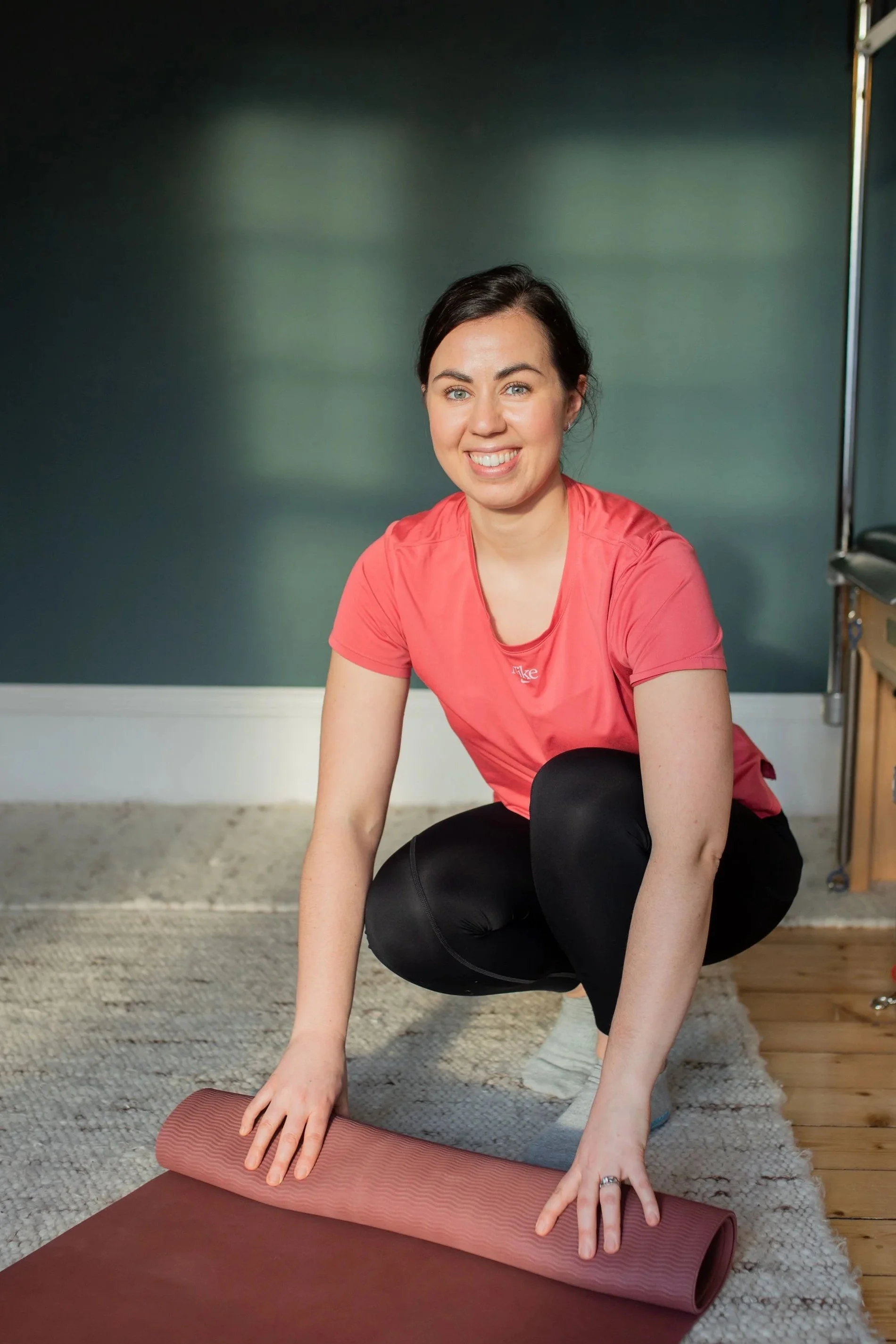
About Ailsa
Ailsa is the founder of Nutrio Physio & Pilates and leads all post-natal sessions herself. She holds an MSc in Physiotherapy, a BSc in Nutritional Therapy, Polestar Pilates qualifications from Sydney, and specialist training in pre- and post-natal Pilates. She is registered with the Health and Care Professions Council (HCPC PH127188) and is a member of the Chartered Society of Physiotherapy (CSP 112899).
She set up Nutrio because she wanted to build the kind of post-natal care she felt was missing — calm, clinically grounded, and built around the woman in the room rather than a template. If you book in, she'll be the one who sees you.
What we work on, and why
Diastasis recti recovery
Diastasis recti — the separation of the abdominal muscles down the centre of the belly — is very common after pregnancy. It often improves on its own in the early months, but for many women it doesn't fully resolve, leaving a soft, doming, or coning sensation through the middle. Pilates that has been adapted for diastasis — focusing on the deep core, breathing mechanics, and avoiding loaded crunching or twisting too early — helps the tissue knit back together properly. Ailsa will assess your separation in your first appointment and build your programme around what your tummy actually needs.
Pelvic floor rehabilitation
Leaks, urgency, heaviness, prolapse symptoms, or just a vague sense that things don't quite feel right — these are not things you have to live with. The pelvic floor responds beautifully to the right kind of work, and Pilates is one of the most effective ways to integrate it. We don't treat the pelvic floor as a separate muscle to clench in isolation; we work it as part of the whole core system, the way it's actually designed to function.
C-section scar mobility and core re-engagement
A c-section is major abdominal surgery, and the scar — even years later — can affect how your core, back, and hips move. We work gently with scar tissue mobility, breath, and graded loading of the abdominal wall, so that you can rebuild strength without the pulling, numbness, or disconnection that often lingers after a c-section. There is no time limit on this work; it helps whether your c-section was last year or fifteen years ago.
Posture and back, neck and shoulder pain
The breastfeeding stoop. The hours of pushing the buggy. The way you instinctively carry a baby on one hip. Post-natal life is hard on the upper back and neck, and on the lower back too. We unpick the patterns that are causing your pain and rebuild the strength that supports your spine through everyday life with small children.
Strength to come back to the things you love
Running, lifting, hiking, dancing, chasing your toddler up a hill — the goal is not just to recover, it's to come back stronger and more confident in your body than before. Once the foundations are in place, we progress your work so that you can return to whatever movement you love, safely and well.
When can I start post-natal Pilates?
-
Most women can start post-natal Pilates from six weeks after a straightforward vaginal birth, once your GP has signed off your six-week check. If your birth involved tearing, an episiotomy, or any complications, we may recommend waiting a little longer or starting with a one-to-one assessment first.
-
After a c-section, we usually recommend waiting eight to twelve weeks, and always until your GP has cleared you to return to exercise. Your scar needs time to heal internally, not just on the surface. When you do start, we begin very gently — there is no rush.
-
There's no upper limit on the work itself. Whether your baby is six months, two years, or twenty years old, your body is still post-natal and all of it still applies — the diastasis, the pelvic floor, the c-section scar, the back that has never quite been the same since. Some of the women we see are years past the birth and finally giving their body the attention it deserves. The Post-Natal Starter is a good place to begin at any stage.
The Friday class is a slightly different question, because there are babies in the room. It's set up for little ones up to around eighteen months — the space is safe for babies who are on the move, but once they're properly walking and curious, fifty minutes is a long time to ask of them, and you'd spend it watching rather than moving.
If your baby is past that stage you're still very welcome — it just tends to work better one-to-one, or in one of our regular classes. Get in touch and we'll work out which fits your week.
-
If you're reading this while still pregnant, brilliant — the earlier you plan your post-natal return, the better. Get in touch and we'll talk through what to expect and when to start.
Your Questions, Answered
-
Yes. We ask that you have had your six-week check after a vaginal birth, or your eight-to-twelve-week clearance after a c-section, before joining post-natal classes. This is standard practice and keeps you safe.
-
Diastasis recti is the separation of the abdominal muscles down the centre of the belly. You might notice a doming, coning, or soft gap running vertically when you sit up from lying down, or your tummy may simply feel weak and unsupported. We assess for diastasis in your first appointment and build your work around what we find.
-
Yes, when it is adapted properly and started at the right time. After a c-section we usually wait eight to twelve weeks and always until your GP has cleared you. We begin very gently, with breath and scar mobility work, and progress as your body is ready.
-
Post-natal Pilates is built around a body that has been through pregnancy and birth. It avoids the loaded crunching and twisting that can make diastasis worse, focuses on the deep core and pelvic floor as a connected system, and progresses far more gradually than a standard class.
-
Yes. The pelvic floor is integrated into every session, not treated as a separate exercise to clench in isolation. Most women notice improvements within a few weeks. If your symptoms need more focused attention, a one-to-one with Ailsa can be added alongside your classes.
-
Yes — babies up to around eighteen months are very welcome, and many of the mums who join us bring their little ones. The room is safe for babies who are crawling and on the move. If you need to pause to feed, change, or settle at any point, you can — no one minds, and you'll often find you're not the only one doing it.
-
Absolutely. Breastfeeding is no barrier to starting Pilates. Wear something supportive, bring water, and let Ailsa know so she can offer any modifications you need for comfort.
-
From six weeks for an uncomplicated vaginal birth, and from eight to twelve weeks after a c-section — both with GP clearance. There is no upper limit. We work with women whose babies are months old and women whose babies are now adults. There's no upper limit on the work. The Friday class, though, is set up for mums with newborn babies up to around eighteen months — after that, one-to-one or a regular class generally suits better. If you’re unsure get in touch and we’ll help direct you.
-
The introductory offer is three classes for £45. Ongoing class passes are listed on our Group Classes page. If you need a physiotherapy assessment first, that is a separate appointment. When you've finished your Post-Natal Starter and want to keep coming, the mat-only class pack is ten classes for £140 — £14 each, you can use over three months. It covers Postnatal Pilates and our regular Mat Pilates classes, so you can keep your Friday morning and add another class in the weeks you're up to it.
-
Nutrio Physio & Pilates is at 594 Brook Street, Broughty Ferry, Dundee — just outside Dundee city centre. The studio is calm, warm, and easy to find.
Whenever you're ready, we're here.
Coming back to your body after a baby is one of the most worthwhile things you will do for yourself — and it doesn't need to be rushed, prescribed, or done alone. When you're ready to start, you'll find a calm studio, a small group, and a physiotherapist who knows exactly what your body has been through.
Or get in touch — we'll talk it through together.