Mat vs Reformer Pilates: what's actually different, and which one is right for you
Reformer Pilates
If you've been quietly stalling for weeks because you can't decide whether to book mat or reformer — this is for you.
Most people who walk through our door have already done their research. They have Googled. They have read the reviews. They know they want to try Pilates. The thing that holds them back is one small, surprisingly stubborn question: mat or reformer, which one am I supposed to book?
The honest answer, before the explanation
Both work. Neither is better. They are different tools, designed to make the same principles — control, breath, alignment, strength — available to different bodies on different days.
If you have been trying to pick the "right" one before you start, you have been overthinking it. That is understandable. Most fitness language is built around hierarchy: which workout is harder, which class is more advanced, which equipment is more serious. Pilates does not actually work that way. So before we go further: there is no wrong door here. The question is which door feels easier for you to walk through.
What mat Pilates actually is
Mat Pilates is what you imagine when someone says "Pilates" without specifying — a mat on the floor, you in comfortable clothes, the work happening through your own body weight. Sometimes a small ball, a band, or a light weight. Often nothing at all.
The thing people misunderstand about mat work is how much is happening underneath it. It looks simple from the outside. You are lying down. You are moving slowly. There is no machine. But mat Pilates is asking your deep stabilising muscles to work in a very specific way, with very little to lean on. Your own body has to provide all the resistance, all the support, and all the feedback.
That has two consequences worth knowing. First, it can feel surprisingly hard, especially in the first few weeks, even though it does not look like much. Second, it teaches you to be in your body in a way that nothing else does. Once you can find your core in a mat session, you can find it everywhere — on the school run, lifting shopping, standing in the kitchen.
What reformer Pilates actually is
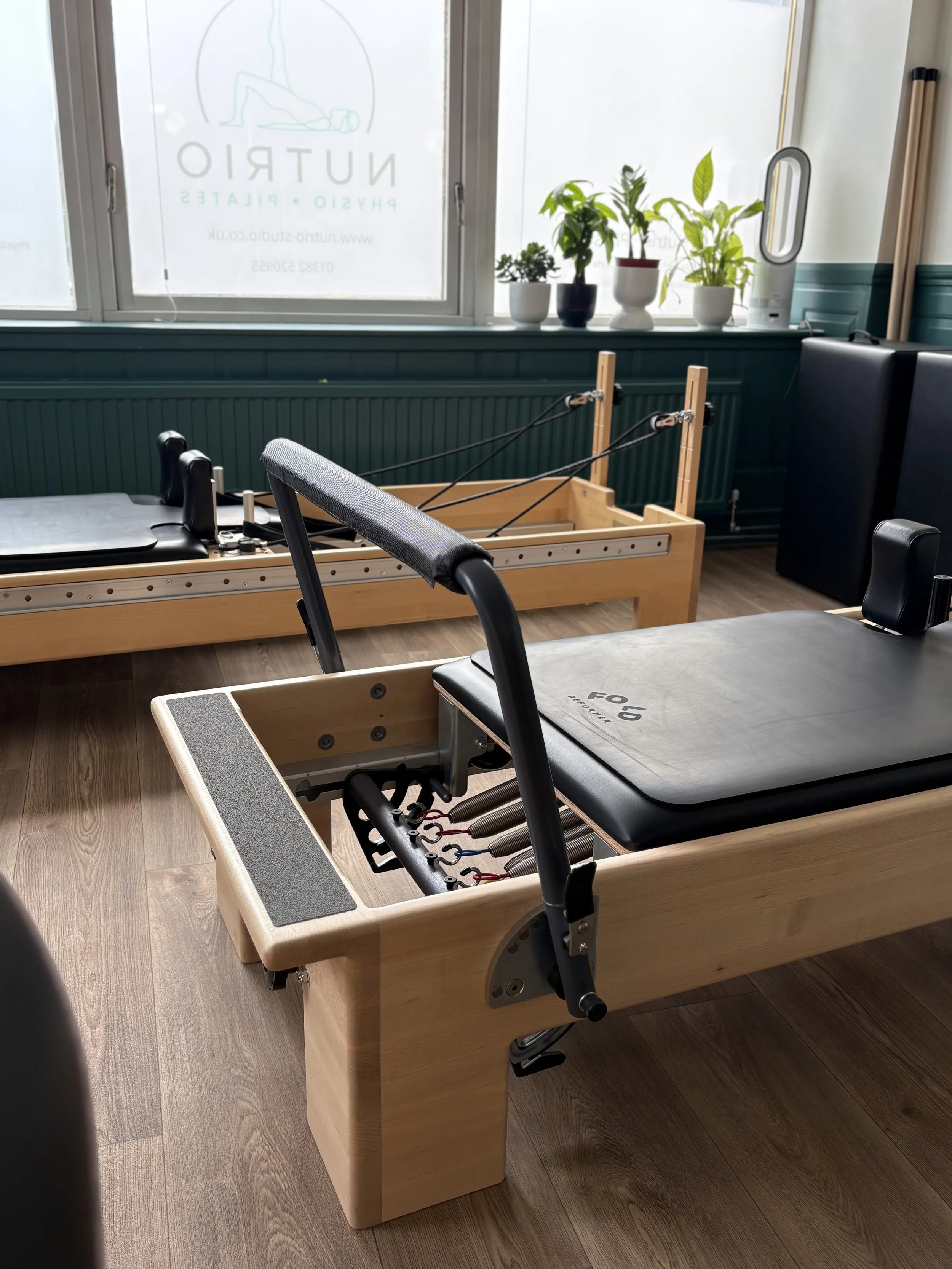
A reformer is a long, wooden bed with a sliding carriage, springs underneath, and straps at one end. It looks intimidating the first time you see one. It is not.
The springs do something extraordinary: they give you both support and resistance in the same movement. If your hips do not quite open the way they used to, the springs help you find the range. If you are stronger than you realised, the springs ask more of you. The same exercise can be made gentler or harder by changing the spring setting — which means a reformer adapts to your body, rather than asking your body to adapt to it.
This is why reformer work feels so different. There is something about the carriage moving under you that makes movement feel possible again — even when your back has been tight for months, even when your knees have not loved the floor for years. The reformer meets you where you are.
How each one feels in the body
Mat work tends to feel slower and more internal. You will notice your breath more. You will be working with gravity, sometimes against it, always with your own weight as the load. After a good mat session, the feeling is often one of subtle openness — like things have moved that you did not know were stuck.
Reformer work tends to feel more dynamic. You are often lying down, but the carriage glides, the springs respond, and there is a sense of being held by the machine while you do the work. After a reformer session, people often describe feeling longer, looser, and surprisingly worked — without ever feeling like they pushed themselves into something.
Which one is right for you
Here is the part most articles get wrong. They give you a list of conditions and tell you which type "treats" each one. That is not really how it works. Both can support the same body in different ways. What matters more is what you are looking for right now.
Reformer or Equipment Pilates can be an easier door to walk through if:
You have a niggle, an injury, or a body that does not feel cooperative right now. The springs make movement more accessible when the floor feels too far away.
You have struggled to find a class that feels safe in the past. The reformer holds you while you work. Many women tell us they feel safer on the reformer than they ever felt in a fitness class.
You like the feedback of a piece of equipment. The reformer tells you when you have stopped moving correctly — gently, but immediately.
Mat Pilates tends to suit you better if:
You want to build a routine you can also take home with you. Mat work translates directly into what you can do on your own bedroom floor.
You want to focus more on the beginning principles of pilates
You already move well and want to deepen what you have rather than learn something new.
You want a smaller weekly investment and the flexibility of joining different class types.
If you are still not sure — and most people are not, the first time — start with whichever one fits your week most easily. Both will teach you something about how your body wants to move. Once you have done a few sessions of either, you will know.
What we would suggest at Nutrio
If you have never done Pilates before, and you are slightly nervous, and you have a body that has been through some things — reformer is a great place to start. If that sounds like you, what actually happens in your first reformer class walks through the whole thing. Our reformer classes run in the upstairs studio or the Studio Circuits Equipment classes are capped at six people. You will not be lost in a crowd, and the equipment will meet you where you are. It is the closest a group class gets to a one-to-one session, without the price tag.
If you have already moved a fair amount and you want to fold something steady into your week, mat Pilates is a beautiful routine to settle into. We would love you in our mat classes — and we would love you in the reformer ones, too.
Whichever one you choose: there is no wrong door. Whenever you are ready, we are here.
You can have a look at the timetable or book your first session. If you would rather ask a question before you book, drop us a message — we will always reply.
Ailsa is a Chartered Physiotherapist (HCPC PH127188, CSP 112899) and Polestar-trained Pilates instructor. Nutrio Physio & Pilates is at 594 Brook Street, Broughty Ferry.