When "it'll probably sort itself out" is true — and when it isn't
There's a particular kind of niggle most of us are excellent at ignoring.
The lower back that's been complaining for a few weeks. The shoulder that catches when you reach for the seatbelt. The knee that aches going downstairs but feels fine going up. The neck that's tight by Thursday and loose again by Sunday.
For most of these, the hope is that if you just leave it alone, it'll sort itself out. And here's the thing — sometimes it does.
The body is genuinely good at repairing itself. Sprains, strains, the wear and tear of a heavier than usual week, a sleep on a strange pillow — these often do resolve on their own, given a few days and a bit of sense.
But sometimes the niggle doesn't sort itself out. Sometimes it goes quiet for a fortnight and then comes back louder. Sometimes it stays the same for months and you stop noticing how much you've changed your life around it — until one day you realise you haven't sat cross-legged on the floor in two years, or you've stopped carrying the shopping in one trip.
This is the post for the in-between place. The niggle that you're not quite sure about. The thing you keep meaning to mention and then don't. How to tell the difference between something that will pass on its own, and something that's asking for a different answer entirely.
What "give it time" actually looks like
A useful starting point: most uncomplicated soft tissue niggles — a pulled muscle, a tweak, a strained ligament — follow a fairly predictable arc.
In the first few days, it hurts. Movement is guarded. You compensate.
In the second week, it should be noticeably better. Not gone, but moving in the right direction. The pain is less, the range of movement is starting to come back, you're using the area more naturally without thinking about it.
By the end of week three, for most simple things, you're functionally back to normal. There might still be a slight memory of it — a small ache after a long day — but it's no longer organising your day around it.
If that's the trajectory you're on, "give it time" is doing exactly what it should.
When "give it time" stops being useful
The reframe I'd offer is this: it isn't the intensity of the pain that tells you something's wrong. It's the shape of it over time.
A few signs that the wait-and-see strategy has run its course:
It's been more than three weeks and it's not improving. Not "it's the same on a bad day" — most things have bad days. I mean genuinely no upward trajectory. If you can't honestly say it's better than it was three weeks ago, that's information.
It keeps coming back to the same place. A back that goes every few months. A shoulder that flares whenever you do anything overhead. A knee that grumbles after every run. Recurrence usually means there's an underlying pattern — a movement habit, a strength imbalance, a load issue — that isn't being addressed. Each individual flare-up might resolve, but the thing that's causing them is still there.
You're changing your life around it. This one is sneaky. You've stopped lifting the toddler with that arm. You've started taking the stairs differently. You can't quite remember the last time you slept on that side. None of these feel dramatic in the moment, but together they're telling you something. A body that's quietly building a no-go list isn't healing — it's adapting around the problem.
It's interfering with sleep. Pain that wakes you, or pain that stops you finding a comfortable position to sleep, deserves attention. Sleep is one of the body's strongest healing levers; if pain is taking it away, the problem isn't passive any more.
It's spreading or changing. A pain that started in one place and has begun referring elsewhere — down the leg, into the arm, across the upper back — is a different kind of niggle from the local one you started with. Same goes for new symptoms: pins and needles, numbness, weakness, a sense that the limb isn't doing what you ask of it.
You're avoiding something you love. Walking. Gardening. Picking up the grandchildren. A class you used to enjoy. The cost of waiting it out has stopped being inconvenience and started being your actual life.
When to see a GP
Before we go any further — a small list of symptoms where neither "give it time" nor a movement class is the right answer. The NHS lists the warning signs that mean back pain needs urgent attention — if you're in any doubt, check there or call 111. These need a GP or, depending on severity, A&E:
New back pain alongside loss of bladder or bowel control, or numbness around the saddle area
Sudden, severe pain after a fall, especially in someone over 50 or with osteoporosis
Pain accompanied by fever, unexplained weight loss, or feeling generally unwell
Calf pain that's hot, red and swollen — particularly after travel or surgery
A joint that's hot, red, swollen and exquisitely painful to move
New weakness in a limb, or loss of fine motor control
Chest pain or breathlessness alongside the pain
This list isn't to alarm anyone — most niggles are nothing like this. But if any of them apply, please don't wait.
What the recurring kind of niggle is actually asking for
Right. For everything that isn't on that list — the recurring back, the shoulder that flares whenever you do anything overhead, the body that's quietly built a no-go list — the answer is rarely more rest.
It's usually more capacity. A body that's a bit stronger, a bit more mobile, a bit more even than the one that started compensating in the first place. The reason the same niggle keeps coming back is almost always that the thing underneath it hasn't changed.
This is the part most people don't realise. Painkillers and rest manage the flare-up. They don't change the underlying pattern. If a niggle keeps returning to the same place, what your body is asking for isn't another fortnight on the sofa — it's regular, sensible, gradual loading. Movement that meets you exactly where you are and asks just enough of you to build something.
Pilates is unusually good at this, for a specific reason: it's the form of strength work that treats stability, alignment and control as the point — not as an afterthought. The bodies that respond best to it are exactly the ones who've been quietly carrying something for a while. Not athletic, not bendy, not used to "exercising" in the conventional sense. Just bodies that want to stop having to organise themselves around a niggle.
What that actually looks like at Nutrio
There are two ways into it, both small-group, both fully scalable to whatever body you arrive in.
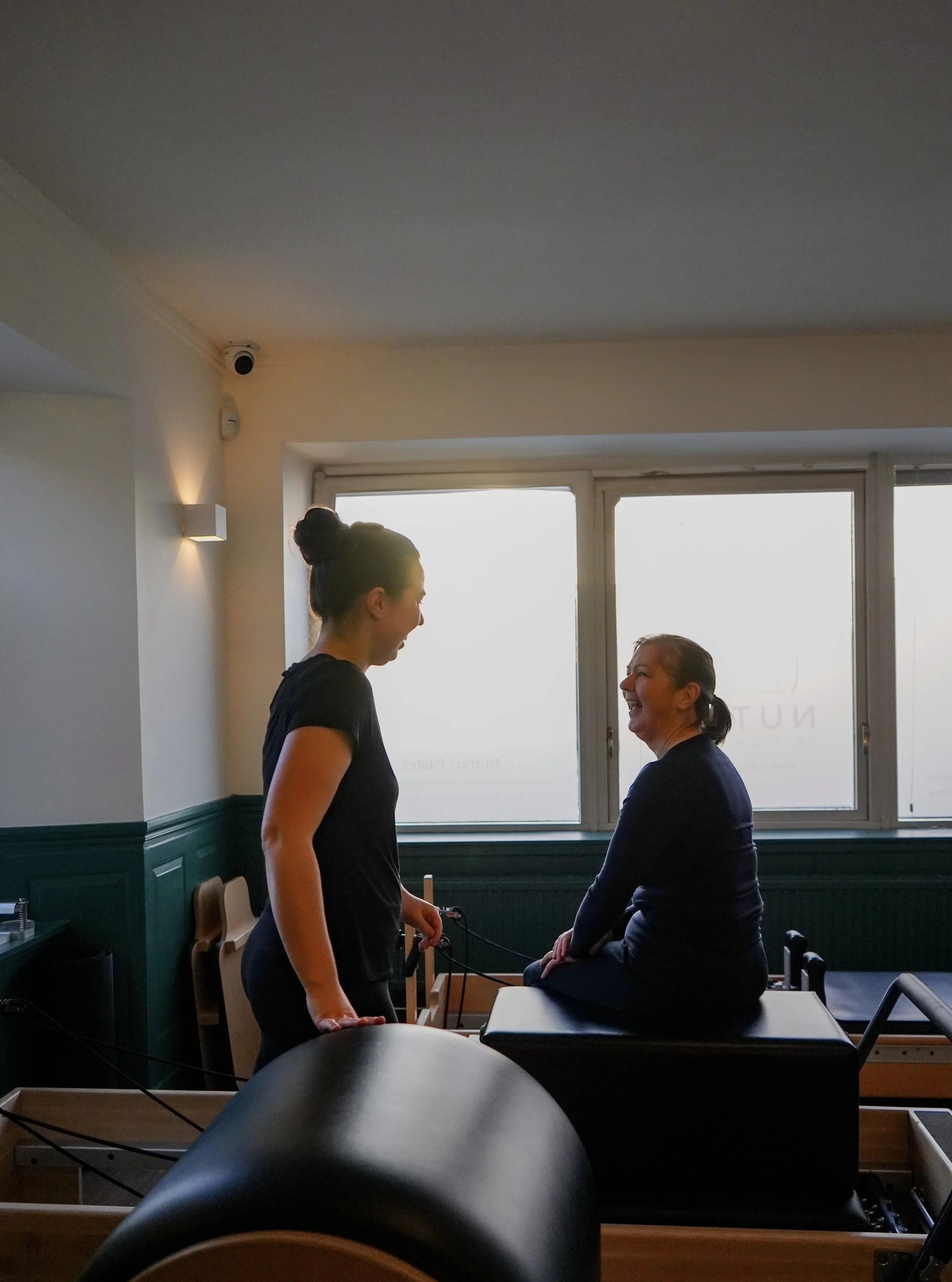
Studio Circuitsis the equipment-based class — a mix of reformer and other studio apparatus. No more than six of you in the room. The equipment is what makes this the kinder option if you've never done Pilates before, if you have an injury you're working around, or if floor work is uncomfortable. The springs both support you and give you something to push against, so the work scales to whatever your body is asking for that day. If it's your back that keeps coming back, reformer Pilates when your back has been trouble goes into that specifically, including the signs that mean an assessment first.
Pilates Mat is mat-based — six maximum. A bit more cardiovascular, slightly more demanding on stability because the floor doesn't help you. Excellent once you've found your feet, or if you already move well and want something portable you can take into the rest of your life.
You don't need to know which one is right before you start. Most people try one, then the other, then settle on the rhythm that fits their week.
The intro offer is three classes for £45, valid for 21 days from your first booking. You can use it across Studio Circuits and Mat — it's designed precisely for the body that wants to test whether this is the answer without committing to anything bigger. No experience needed. No expectation about how you should move. Truly.
The thing I'd want you to take away
If a niggle is improving on its own arc, leave it alone. Your body is doing what it does.
If it's been three weeks and you're not moving forward, or it keeps coming back to the same place, or you've quietly started organising your life around it — that's not a wait-and-see situation any more. That's a let's build something underneath it situation.
You don't need to be in agony to deserve attention. You don't need a dramatic story. "I'm just a bit fed up of this thing keeping coming back" is one of the most common reasons people start with us, and it's a perfectly good one.
Whenever you're ready, we're here.
Ailsa Bell MSc BSc is a Chartered Physiotherapist and Pilates teacher at Nutrio Physio & Pilates in Broughty Ferry. HCPC registered, CSP member. This blog is general information and not a substitute for individual clinical advice — if any of the red flags above apply to you, please seek urgent medical attention.