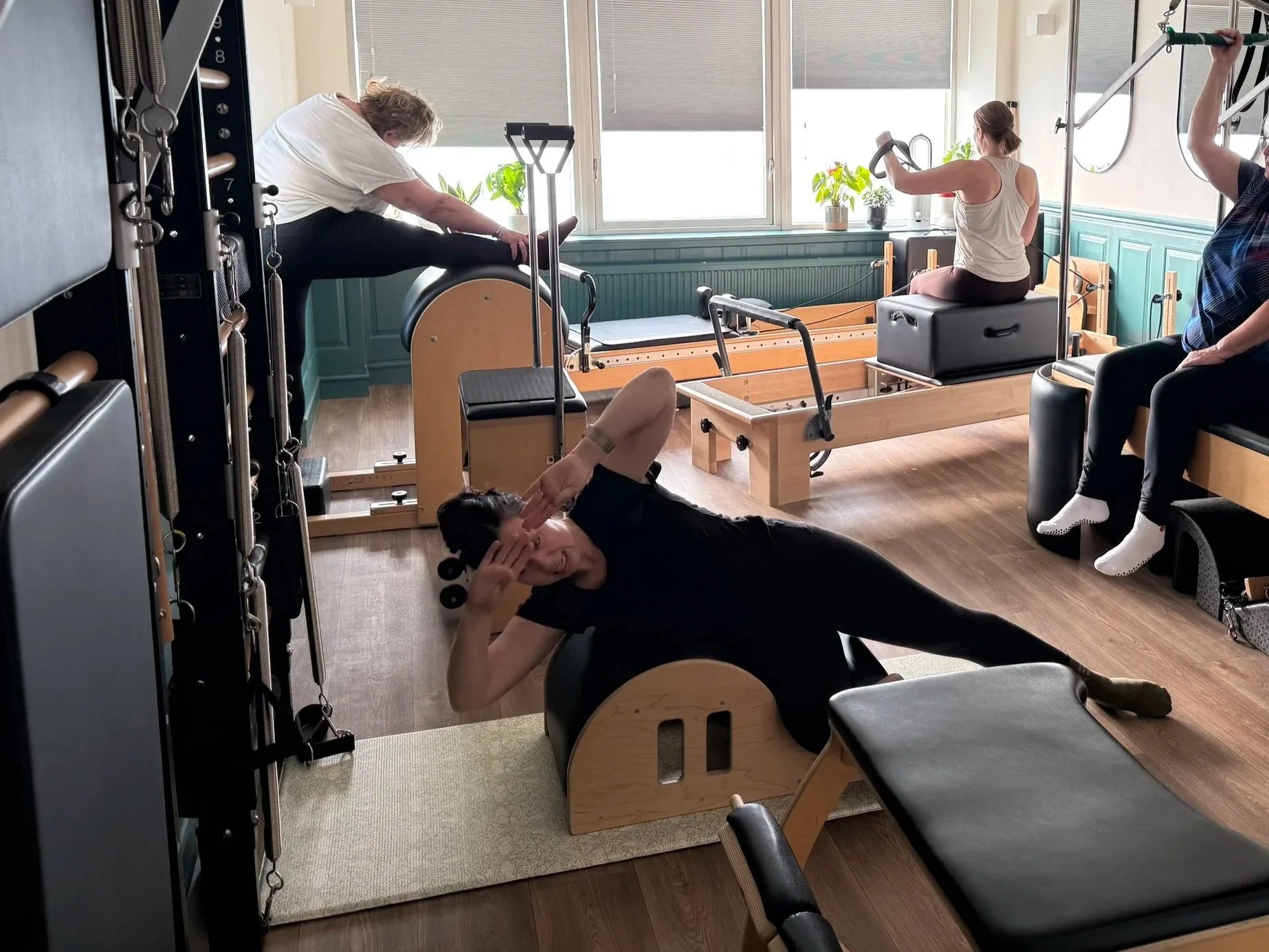
Studio Circuits Class
You're not too stiff for Pilates. Stiffness is one of the best reasons to begin, because a body that's seized up usually needs more gentle, regular movement, not less of it.
I hear some version of this question a lot, often from someone who's been meaning to book for months: "I'll come once I've loosened up a bit." I understand the instinct. But waiting to feel less stiff before you start is a bit like waiting to feel rested before you go to bed. The thing you're waiting for is what the class is there to help with.
Stiffness is a reason to start Pilates, not a reason to wait
If your back's been giving you grief, your hips feel like rusty hinges first thing, or bending to the bottom shelf has become a small negotiation, you're exactly who our classes are designed around. Nobody arrives at the studio supple. Most people arrive a bit stiff, a bit unsure, and quietly convinced everyone else will be bendier than them.
Pilates doesn't ask you to bring flexibility with you. It builds strength and control through the range you've got today, and that range tends to grow as you use it.
Why does your body feel so seized up?
Your body is very good at adapting to what you ask of it, and that includes asking very little. If most of your week is spent sitting at a desk, driving, or on your feet looking after everyone else, your joints and muscles spend a lot of time in the same few positions. Over months and years, the body settles into that smaller range because it's the only one it's being asked to use.
An old injury can add to it. After a sore back or a sprained ankle, it's natural to move more carefully, and sometimes that careful way of moving outlasts the injury itself by years.
None of this means your body is letting you down. It means it's been doing what you've asked of it. Change what you ask, gently and regularly, and it has something new to adapt to.
Flexibility is something Pilates builds, not something it asks for
This is the part that most often surprises people. In a Pilates class, you aren't being measured against a pose you have to reach. Every exercise has a version that fits the body in front of it: a shorter range, a different starting position, more support or less.
That's the why behind the way we teach. You work where you are, with control, and you build from there. Flexibility is an outcome of the work, not the ticket in. And because the focus is on control rather than pushing into a stretch, it suits a body that's been guarded for a while.
The NHS lists Pilates among its examples of muscle-strengthening activities, and recommends strengthening all the major muscle groups on at least two days a week. Strength and mobility aren't two separate projects. Moving well through a range is what keeps that range yours.
The reformer helps a stiff body more than you might expect
If you're stiff, the reformer is often a kinder place to start than the mat. On a mat, the floor gives you nothing back, and just getting down to it and up again can feel like the hardest part of the class.
On a reformer you lie on a padded carriage with your head supported, and springs underneath that can assist your movement as well as resist it. The machine holds you while you work. That means your instructor can set things up so you move through a comfortable range with support, and then gradually ask a bit more as your body allows.
A few things worth knowing before you choose a class:
Reformer | Foundation is the place to start. Nothing is assumed, the machine gets explained, and there's no prerequisite.
Reformer | Control takes the same exercises with slower, more deliberate transitions. It's hard work, not an easier class, and it suits anyone who finds a quicker pace too much while they're finding their feet.
Studio Circuits runs downstairs, with everyone on their own programme. If the stairs up to the Tower studio would be a struggle, this is a lovely alternative.
Classes are never bigger than six, so your instructor can see how you're moving and adjust your springs and positions as you go. You can read more about each class on our reformer Pilates page.
What your first few weeks are likely to feel like
Your first class might feel a little clumsy. That's normal for everyone, whatever their fitness. Learning where your feet go and what the springs are doing takes a session or two.
You may notice muscles the next day that you'd forgotten about: inner thighs, the sides of your ribs, between your shoulder blades. A bit of ordinary muscle soreness that settles within a day or two is a fair sign something has been asked to work that hadn't been for a while.
What we're working towards, at your own pace, is the everyday stuff. Getting out of the car. Reaching into the back of a cupboard. Turning to check a blind spot without your whole body coming with you. That's what strength and mobility are for.
When stiffness is worth getting looked at first
Most everyday stiffness is a body asking to move more. Sometimes, though, it's worth getting advice before you book a class.
It's worth a check if your stiffness is new and getting steadily worse, comes with swelling, heat or redness in a joint, wakes you at night, or followed a fall, or if you feel generally unwell with it. In any of those cases, please speak to your GP or book a physiotherapy assessment before you start. The same goes for pain that gets worse when you move rather than easing. The NHS advice on back pain is to stay active, and to stop and see a GP if your pain gets worse.
I can't tell you what's going on with your body from a blog post, and I wouldn't want to guess. An assessment is how we find the right starting place for you.
Questions people ask about stiffness and Pilates
Do I need to stretch or get fitter before my first class?
No. The class warms you up, and your instructor sets the reformer up for your height and build before you start. Just arrive ten minutes early in comfortable clothes and grip socks.
Is reformer or mat Pilates better if I'm stiff?
For many stiff bodies the reformer is the easier start, because the springs and carriage give you support that the floor can't. Mat work is lovely too, but it asks more of you to hold yourself in position from day one.
What if I struggle to get down to the floor?
On the reformer you lie on the carriage rather than the floor, and your instructor will show you how to get on and off it. In Studio Circuits, the equipment lets you work lying, sitting or standing.
How often should I come?
Whatever your week can hold. Twice a week is a lovely rhythm and is in line with the NHS guidance on strengthening, but once a week, kept up, still counts.
Will it hurt?
It shouldn't. Feeling your muscles work is normal. Sharp pain, or pain that's worse the following week rather than better, isn't, so mention it to your instructor at the time.
Whenever you're ready
If you've been waiting to feel less stiff before you start, this is your sign that you don't need to. The simplest way to try it is our intro offer: three group classes for £45, valid for 21 days, reformer included. Book Foundation first and let us do the rest. If it feels like home, our class packs of 5, 10 or 15 keep it going. You'll find everything about getting started on our New to Nutrio page.
All you need to do is arrive exactly as you are. Whenever you're ready, we're here.
Ailsa Bell MSc BSc is a Chartered Physiotherapist and Pilates teacher at Nutrio Physio & Pilates, 594 Brook Street, Broughty Ferry. HCPC registered (PH127188), CSP member (112899). This blog is general information and not a substitute for individual clinical advice. If you have a specific injury or condition, please get in touch and we'll point you to the right starting place.